
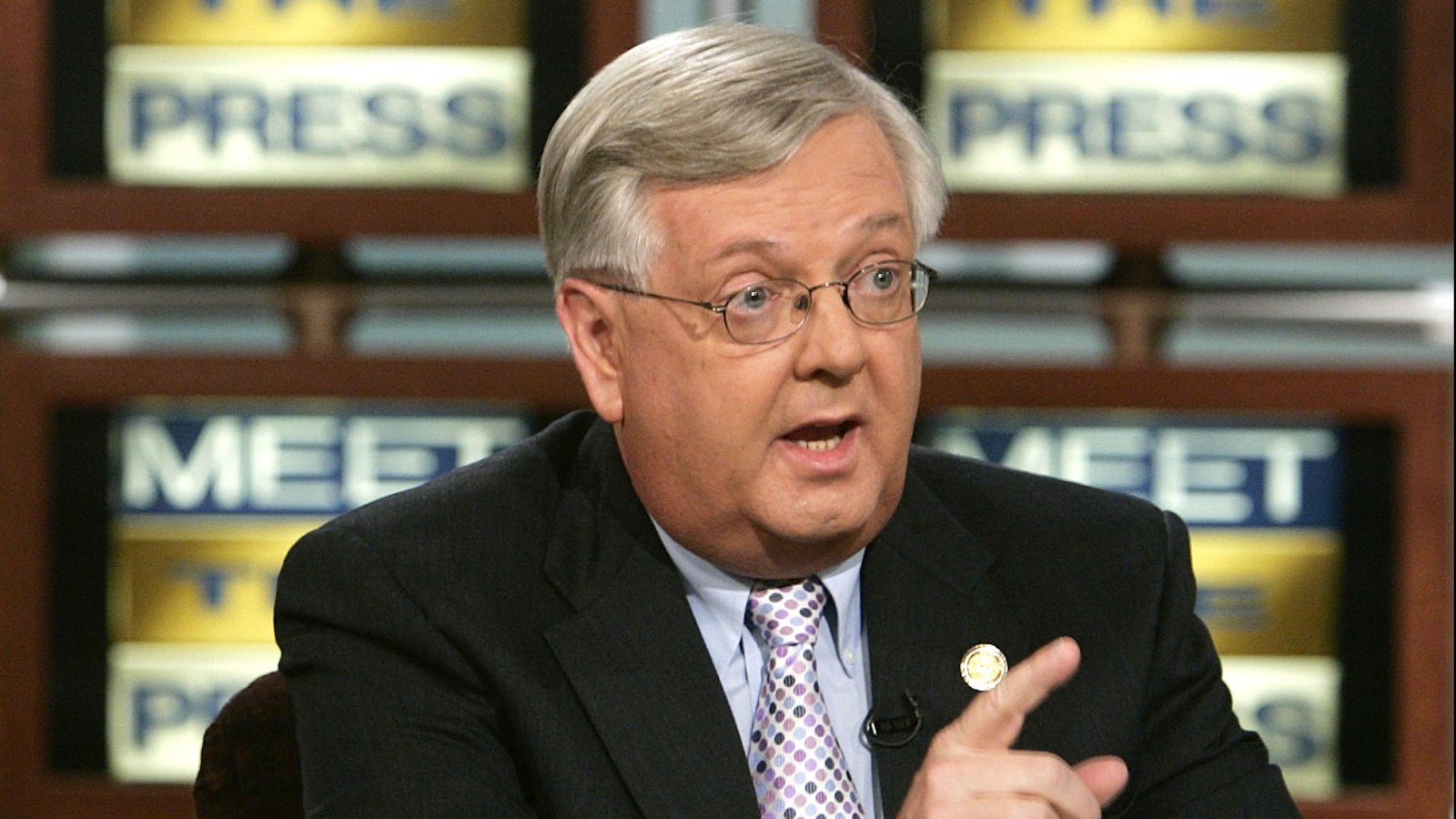
Earlier this month, The Atlantic's Natasha Bertrand revealed former Congressman Curt Weldon's connection to the ongoing Russia investigation and how he allegedly was upset the media uncovered the meeting during which former Ukrainian Parliament member Andrii Artemenko presented a Ukrainian peace plan to Felix Sater and Michael Cohen (Cohen reportedly then delivered the plan to Michael Flynn) because he already had funding from Viktor Vekselberg to promote the plan.
Now, McClatchy DC has more information about Weldon and his involvement, as well as that of billionaire real estate investor Alexander Rovt.
Ex-Ukrainian legislator Andrii Artemenko told McClatchy in several recent interviews that the peace proposal, which some analysts believe had a pro-Moscow tilt, was hatched in February 2016 during side discussions at a Ukraine-focused conference at Manor College in suburban Philadelphia. Former Republican Rep. Curt Weldon and New York real estate mogul Alexander Rovt were involved, said Artemenko, who also participated.
“It was called the Rovt-Weldon plan,” said Artemenko, noting that he had been friends with Weldon for almost a decade.
Neither the roles of Weldon and Rovt in the early framing of the plan, nor the fact that it was being devised nearly a year before it was given to a Trump associate for delivery to the administration, have been reported previously.
(...)
The proposal would have lifted sanctions on Moscow if the Kremlin withdrew Russian forces from Eastern Ukraine; it also could have permitted Russia to keep control of Crimea, which it annexed in 2014.
(...)
Artemenko said Weldon “introduced me to high society in the U.S.,” including other lawmakers such as Rep. Dana Rohrabacher, R-Calif., who is sometimes called Russian President Vladimir Putin’s best friend in Washington, GOP Sen. Rob Portman of Ohio, and Democratic Rep. Marcy Kaptur of Ohio.
Weldon and Rovt have each had links to Russian business interests.
Weldon’s two decade career in Congress ended with the 2006 elections, weeks after the FBI raided his then-29-year-old daughter’s office and home. The Justice Department was probing his actions to support a Russian-managed oil and gas company that gave his daughter a $500,000 contract to do public relations work, Soon after the contract was signed, Weldon helped corral some 30 lawmakers for a dinner, which his daughter’s firm worked on too, to honor the chairman of the Russian company, Itera International Energy Co, and Weldon also intervened to help Itera when federal agencies canceled a contract with the company. Weldon was never charged.
Rovt made his fortune initially in the fertilizer business, with some operations in Russia, but sold most of his foreign fertilizer assets in 2007 to another Ukrainian, oligarch Dmitry Firtash, who was a chief financier of ex-President Viktor Yanukovych’s pro-Russian political party before Yanukovych was ousted in 2014 and fled to Moscow. That party paid millions of dollars to yet another figure in the Trump-Russia investigation, lobbyist and political consultant Paul Manafort, who was a key Yanukovych adviser before he became Trump’s campaign chairman. Manafort has since been indicted by two Mueller grand juries on charges including money laundering, tax evasion, bank fraud and obstruction.
(...)
Rep. Adam Schiff, the leading Democrat on the House Intelligence Committee and an outspoken critic of Russia’s interference in the 2016 elections, said in a statement that “The fact that this proposal was being considered a year in advance of its provision to the White House raises serious questions about how far along the discussion had progressed and the extent to which Russia was involved in the planning or consideration of the proposal.”
(...)
Schiff also noted that investigators for the committee had long “been interested in the Trump Administration’s potential willingness to provide Russia a significant giveaway that might be at odds with the foreign policy position of the United States and our allies.”
(...)
On June 8th, Artemenko testified for several hours before a Washington, D.C., grand jury tied to the Mueller investigation. The Ukrainian, who was ousted from his country’s legislature and lost his citizenship because of fallout from the initial revelation of the plan and its perceived pro-Moscow tilt, said that Cohen was a major focus of the grand jury questions he fielded.
After his grand jury appearance, Artemenko added, he realized that Cohen “is a target” of interest to Mueller.
(...)
Artemenko said he never gave Cohen anything in writing about the plan. But a few days after they met, Sater phoned the Ukrainian and read him a few sentences that contained the gist of it; Artemenko signed off on the language — which Sater described as “four bullet points” — for Cohen to give to Flynn.
A few days later Artemenko said that in another call with Sater he was informed that “the package had been delivered” to Flynn.
Cohen has offered shifting and contradictory statements about what he did with the document. Initially, he told the New York Times that he delivered the plan to Flynn’s office.
But Cohen quickly changed his story, telling the Washington Post within days that he never gave it to Flynn or anyone in the White House. Then Cohen changed his account again in two subsequent interviews. He said at one point that he threw the envelope, unopened, in the trash.
These contradictory accounts by Cohen have likely spurred Mueller’s team to look more closely at the plan, say former prosecutors.
Inside the Ukraine peace plan in Mueller probe: More authors, earlier drafting than believed (McClatchy DC)