
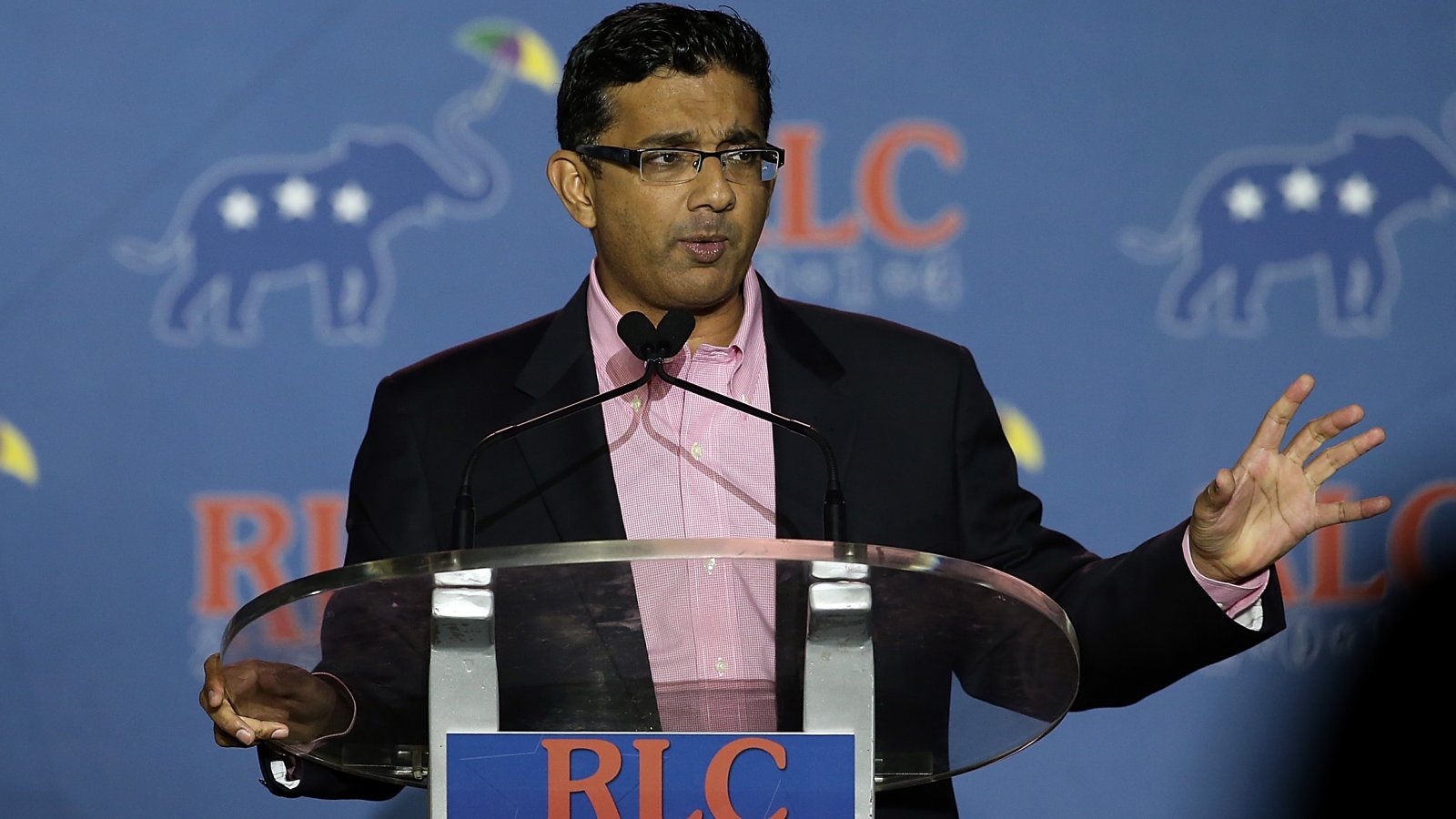
President Trump issued a full pardon to conservative commentator Dinesh D’Souza Thursday and indicated he also may do the same for former Democratic Illinois governor Rod Blagojevich and celebrity homemaker Martha Stewart.
With Thursday’s announcements, Trump also delivered an indirect but unmistakable message to personal attorney Michael Cohen, former national security adviser Michael Flynn and others ensnared in Trump-related investigations that they, too, could be spared punishment in the future.
D’Souza, Blagojevich and Stewart had been convicted of such crimes as campaign-finance violations or lying to investigators — charges similar to those brought against Flynn, former Trump campaign manager Paul Manafort and other Trump associates indicted in special counsel Robert S. Mueller III’s Russia investigation. Cohen, meanwhile, is under investigation by federal prosecutors in New York for possible campaign-finance violations and other possible crimes.
At the same time, D'Souza, Blagojevich, and Stewart all were prosecuted by Department of Justice officials against whom the president appears to hold a personal grudge.
Former FBI director James B. Comey, whom Trump fired last year, prosecuted Stewart in her insider-trading case, while Comey’s close friend, former U.S. attorney Patrick J. Fitzgerald, prosecuted Blagojevich. Former U.S. attorney Preet Bharara — who, like Comey, was fired by Trump and has since been an outspoken critic — prosecuted D’Souza.
Roger Stone, Trump's longtime friend and political advisor, confirmed the president was acting deliberately to send a message.
“It has to be a signal to Mike Flynn and Paul Manafort and even Robert S. Mueller III: Indict people for crimes that don’t pertain to Russian collusion and this is what could happen,” Stone said. “The special counsel has awesome powers, as you know, but the president has even more awesome powers.”
There does not seem to be any legitimate reason D'Souza should be pardoned. When charged four years ago, he pleaded guilty and expressed remorse for his actions.
D’Souza is an author, filmmaker and provocateur who became a cult figure on the right in part because of his conspiratorial polemics about Barack Obama and Hillary Clinton. He pleaded guilty in 2014 to illegally using straw donors to contribute to a New York Republican candidate for U.S. Senate, telling a judge that he knows what he did was “wrong” and “I deeply regret my conduct.”
Prosecutors said D’Souza had other individuals donate money to Republican Wendy Long, a Republican who was challenging Sen. Kirsten Gillibrand (D-N.Y.) in 2012, under the agreement that he would reimburse them for the donations.
D’Souza was sentenced to five years of probation, including eight months living under supervision in a “community confinement center” in San Diego, and a $30,000 fine.
Trump claimed he never had met D'Souza before calling him Wednesday night, but that is not true.
... Sam Nunberg, Trump’s former political aide, recalled that D’Souza visited Trump at Trump Tower in New York in 2012, shortly before releasing his film, “2016: Obama’s America,” which was based on his earlier book, “The Roots of Obama’s Rage.”
Nunberg said that Trump agreed to help D’Souza promote the film. Trump sent three tweets about D’Souza’s movie that August, including one calling it an “amazing film.”
The president has been acting on pardons without consulting the DOJ.
Traditionally, people seeking pardons apply through the Justice Department’s Office of the Pardon Attorney, which reviews thousands of cases and advances some to the White House for the president’s consideration.
But Trump has used his clemency powers in a more haphazard way, spurred by personal connections or political calculations. Most of the pardons are impulsive, according to a person familiar with the process, and are driven by his “seeing something on TV, reading something in a newspaper, hearing from a friend or someone lobbying him personally.”
Trump pardons conservative pundit Dinesh D’Souza, suggests others also could receive clemency (WaPo)