
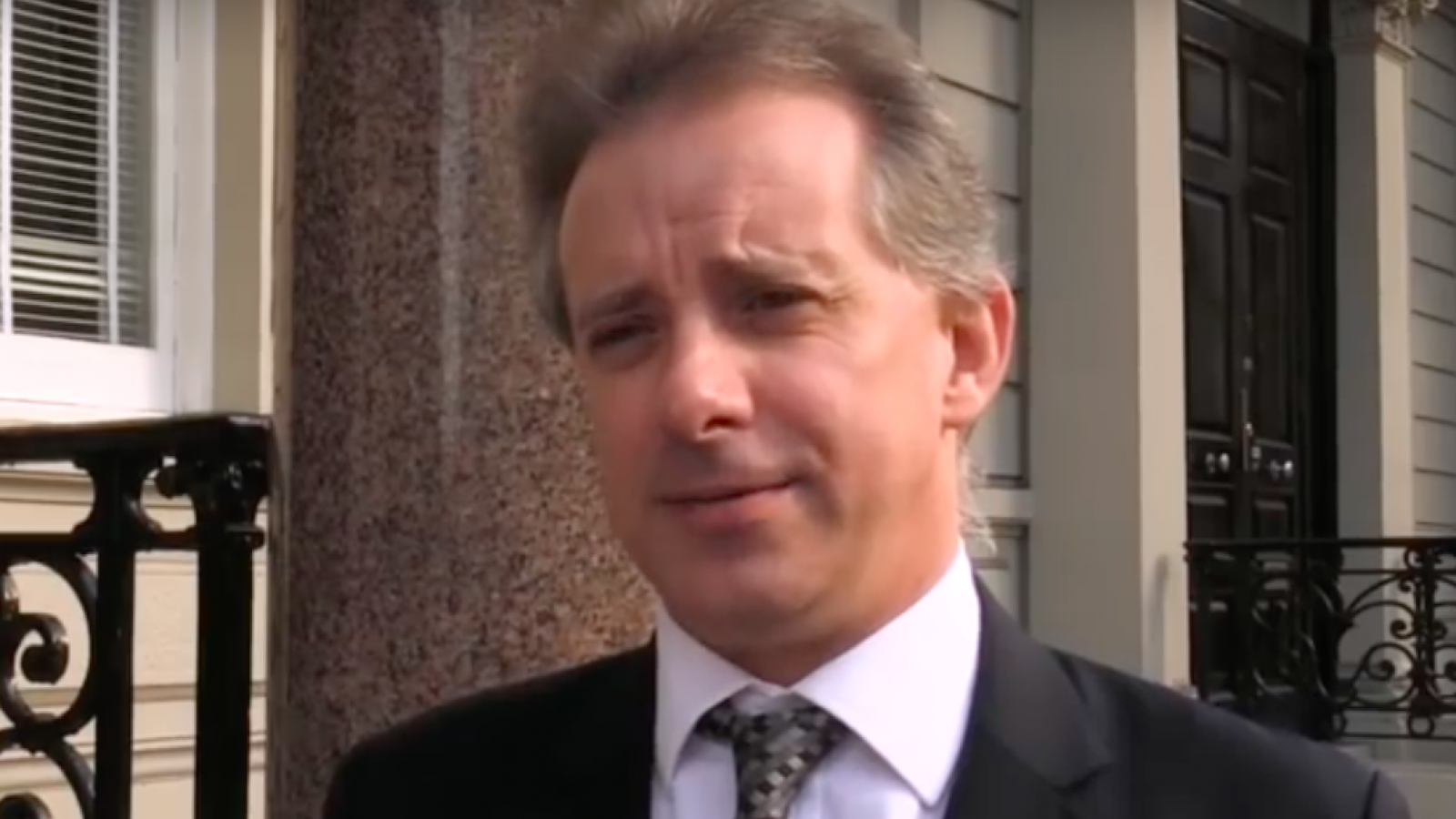
The Washington Post has a detailed accounting of how and why former British intelligence officer Christopher Steele brought the information he discovered about Donald Trump during the 2016 campaign to the FBI.
For months, the British former spy had been working to alert the Americans to what he believed were disturbing ties Trump had to Russia. He had grown so worried about what he had learned from his Russia network about the Kremlin’s plans that he told colleagues it was like “sitting on a nuclear weapon.”
He was now being summoned to Rome, where he spent hours in a discreet location telling four American officials — some of whom had flown in from the United States — about his findings.
The Russians had damaging information about Trump’s personal behavior and finances that could be used to pressure the GOP nominee. What’s more, the Kremlin was now carrying out an operation with the Trump campaign’s help to tilt the U.S. election — a plot Steele had been told was ordered by President Vladimir Putin.
The Post explains the FBI listened to Steele because of his experience and expertise.
"[A] Russia expert so well-trusted that he had assisted the Justice Department on past cases and provided briefing material for British prime ministers and at least one U.S. president. During intense questioning that day in Rome, they alluded to some of their own findings of ties between Russia and the Trump campaign and raised the prospect of paying Steele to continue gathering intelligence after Election Day, according to people familiar with the discussion.
Steele has kept a low profile since being identified as the source of the memos that became the now infamous dossier.
Friends and former colleagues said he has been dismayed by the attacks on him, particularly a criminal referral about his actions that two U.S. senators made to the Justice Department, accusing him of lying about his contacts with news organizations. The move was viewed by some British lawmakers and longtime intelligence officials as an affront to the special bond between the United States and Britain.
By all accounts, Steele's motivation for sharing the information he was uncovering about Russian influence and interference in the 2016 U.S. election came from a deep understanding of how the Kremlin operates and a sense of duty and honor.
Those who know Steele say he grew increasingly alarmed about the prospect of the election of a U.S. president who he believed could be unduly swayed by Moscow. As his anxiety drove him to reach out to the FBI, he also met with journalists from several news organizations, including The Washington Post.
Steele left the British intelligence service in 2009 and opened his own intelligence consulting firm. When he contacted the FBI with the information he had gathered for Fusion GPS about Donald Trump, it was not Steele's first time sharing valuable information with U.S. officials.
Among those who have continued to seek his expertise is Steele’s former boss Richard Dearlove, who headed MI6 from 1999 to 2004.
In an interview, Dearlove said Steele became the “go-to person on Russia in the commercial sector” following his retirement from the Secret Intelligence Service. He described the reputations of Steele and his business partner, fellow intelligence veteran Christopher Burrows, as “superb.”
In one of his first cases as a private consultant, Steele worked closely with the FBI in its investigation of corruption at FIFA, the powerful worldwide soccer governing body. Steele, who at the time was working for the English Football Association, shared his research with top officials at the Justice Department. U.S. officials eventually charged 14 top soccer executives and their associates with wire fraud, racketeering and money laundering.
(...)
Steele continued to feed information to the U.S. government, passing along intelligence he gathered about Ukraine and Russia for corporate clients in 2014 and 2015 to a friend at the State Department, according to former assistant secretary of state Victoria Nuland. “He offered us that reporting free, so that we could also benefit from it,” she said Sunday on CBS’s “Face the Nation.”
Commissioned by Fusion GPS to continue the firm's research into Trump's Russian ties, Steele tapped into longstanding connections to gather information.
His sources included “a close associate of Trump,” as well as “a senior Russian foreign ministry figure” and a “former top-level Russian intelligence officer,” both of whom Steele indicated had revealed their information to a “trusted compatriot,” he later reported to Fusion GPS.
Just weeks after taking the case, Steele told friends that the initial intelligence he had gathered was “hair-raising.”
(...)
Steele wrote up his initial findings in late June in the first of 17 memos that later would be known as the dossier ...
Steele told associates that he was so nervous about the explosive nature of the information that he sent the memo via a commercial courier to Washington, rather than electronically.
The Post goes on to detail Steele's interaction with federal law enforcement and the media over the next several months. With the November election fast approaching, Steele grew increasingly concerned with the lack of attention being paid to Russian interference. The FBI said it wasn't interested in publicizing information that could sway an election.
So he was stunned on Oct. 28 when then-FBI Director James B. Comey announced that he was reopening an inquiry into Clinton’s use of a private email server while she was secretary of state. Three days later, the New York Times reported that FBI officials had not turned up evidence that the Trump campaign had links to Russia.
(...)
[Fusion GPS' Glenn Simpson] and Steele decided that “it would be fair if the world knew that both candidates were under FBI investigation,” Simpson said.
They took their story David Corn at Mother Jones.
After Trump won the election, Steele found a way to get his dossier to Senator John McCain (R-AZ) who also brought it to the FBI.
In a private meeting on Dec. 9, McCain gave Comey the dossier — passing along information that Steele had provided to the FBI earlier in the year.
Shortly before Inauguration Day, Comey briefed Trump on the document, alerting him to what the FBI director would later describe to Congress as a report that contained “salacious, unverified” information that was circulating in the media.
Steele’s role would soon emerge publicly. BuzzFeed published the dossier, and then the Wall Street Journal identified him as the author.
Steele went into hiding, leaving his London home with his family for six weeks.
Steele has not been seen much since but reportedly spent two days last September interviewing behind closed doors with Special Counsel Robert Mueller.
Read the full story: Hero or hired gun? How a British former spy became a flash point in the Russia investigation. (WaPo)