
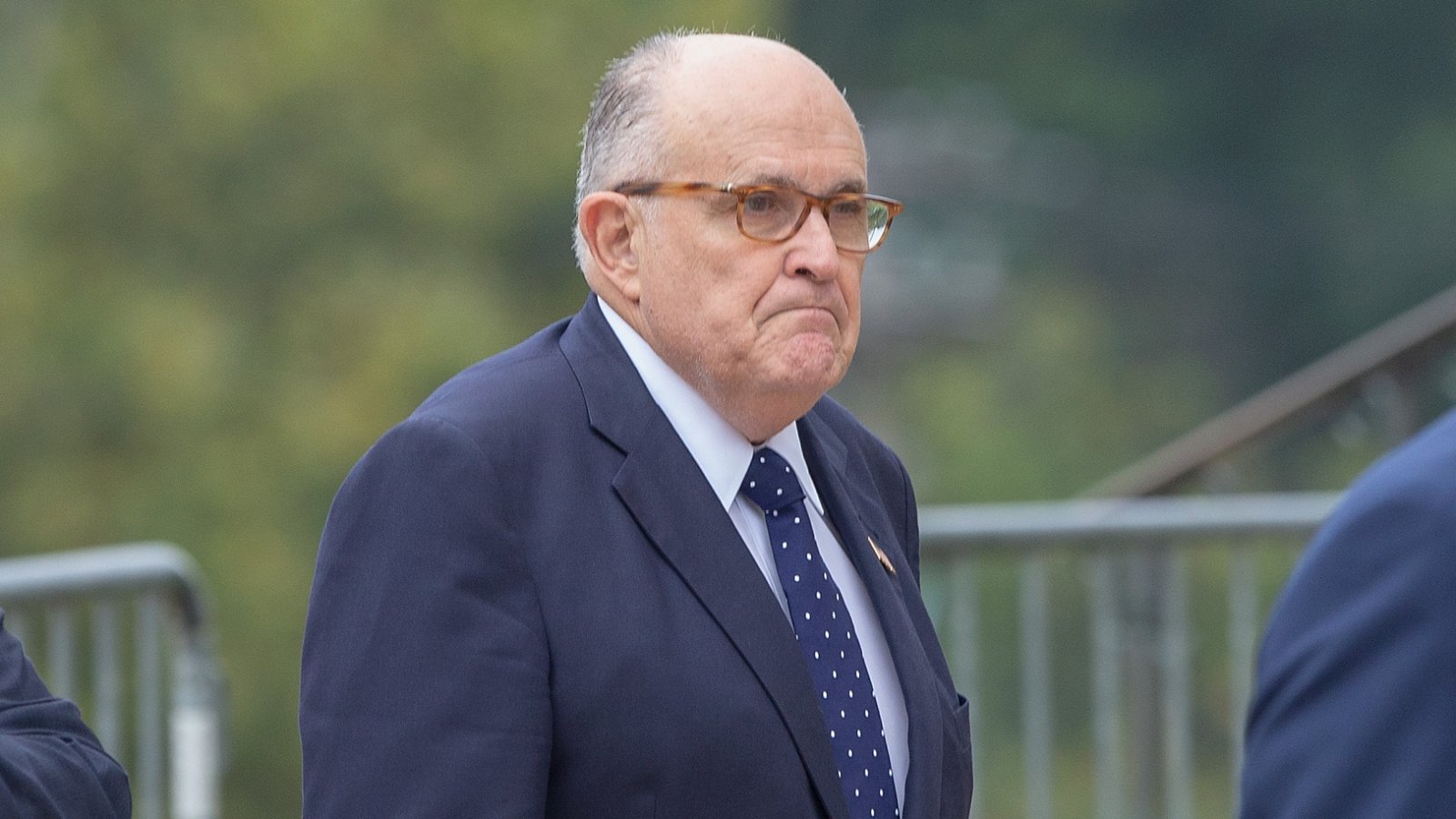
UPDATE: As anticipated, Giuliani already is walking back his remarks to the AP that the president will not answer any questions related to obstruction of justice.
"I think we're pretty close to an agreement, maybe this weekend," Giuliani told POLITICO Thursday night about the prospects of a deal for written responses to questions on alleged collusion between the campaign and Russia before Trump took office.
However, the former New York City mayor said the two sides remain at odds over questioning on issues of obstruction of justice and on whether Trump should be questioned in person by Mueller's team on any issue.
Earlier Thursday, the Associated Press reported that Giuliani said a decision had been reached that Trump would not voluntarily submit to an interview on alleged efforts to thwart the Russia probe.
"That's a no-go. That is not going to happen," Giuliani told the AP. "There will be no questions at all on obstruction."
But Giuliani told POLITICO there has been no final decision on that issue.
"We're very opposed to that [but] we're not closing it off 100 percent," Giuliani said. "We don't want to mislead [prosecutors] and have them think it's easy, but we have also not closed our mind to it."
Asked about the AP report, Giuliani said: "It's a little complicated. I think the AP got it a little wrong, but it could be my fault and I didn't describe it right."
Giuliani says deal near for written questions from Mueller (Politico)
According to the Associated Press, Rudy Giuliani now says President Trump will not answer, neither in writing nor in person, any questions from the special counsel regarding possible obstruction of justice.
[Editor's note: Giuliani's public declarations have been inconsistent and unreliable and should be considered with a healthy dose of skepticism.]
Trump lawyer Rudy Giuliani said questions about obstruction of justice were a “no-go.”
Giuliani’s statement was the most definitive rejection yet of special counsel Robert Mueller’s efforts to interview the president about any efforts to obstruct the investigation into possible coordination between his campaign and Russians. It signals the Trump’s lawyers are committed to protecting the president from answering questions about actions the president took in office.
It’s unclear if Giuliani’s public position has been endorsed by Trump, who has said he wants to answer questions under oath. Negotiations about the scope and format of an interview are still ongoing. If the legal team holds its stance, it could force Mueller to try to subpoena the president, likely triggering a standoff that would lead to the Supreme Court.
Mueller’s office has previously sought to interview the president about the obstruction issue, including his firing last year of former FBI Director James Comey and his public attacks on Attorney General Jeff Sessions. Trump’s legal team has argued that the president has the power to hire and fire appointees and the special counsel does not have the authority to ask him to explain those decisions.
(...)
In a letter last week, Mueller’s team said it would accept written responses from Trump on questions related to Russian election interference. Giuliani suggested Thursday that Trump’s lawyers had agreed to those terms but wanted to prohibit investigators from asking follow-up questions.
“It would be in written form and if you want to follow up on our answers, justify it. Show us why you didn’t get there the first time,” Giuliani said.
(...)
Though the president has publicly said he was eager to face questions from Mueller, his lawyers have been far more reluctant to make him available for an interview and have questioned whether Mueller has the right to ask him about actions that he is authorized, under the Constitution, to take as president.
Mueller’s team raised the prospect in March that it could subpoena the president, though this would unquestionably prompt a court fight.
The Supreme Court has never definitively ruled on the question of whether a president can be forced to testify, though the justices did rule in 1974 that Richard Nixon had to produce recordings and documents that had been subpoenaed.
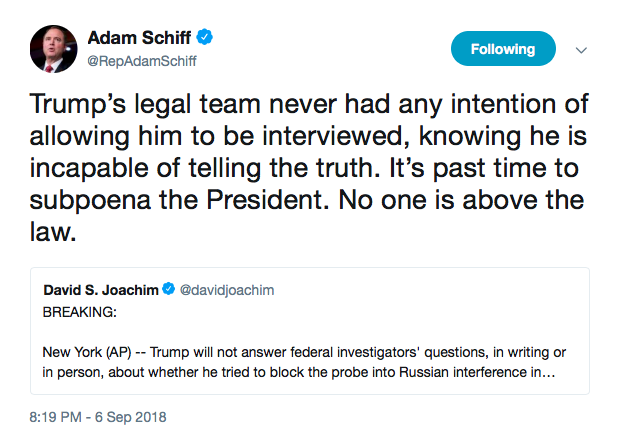
Rep. Adam Schiff (D-CA), Ranking Member on the House Intelligence Committee, tweets enough is enough.
Giuliani to AP: Trump will not answer obstruction questions (AP)