
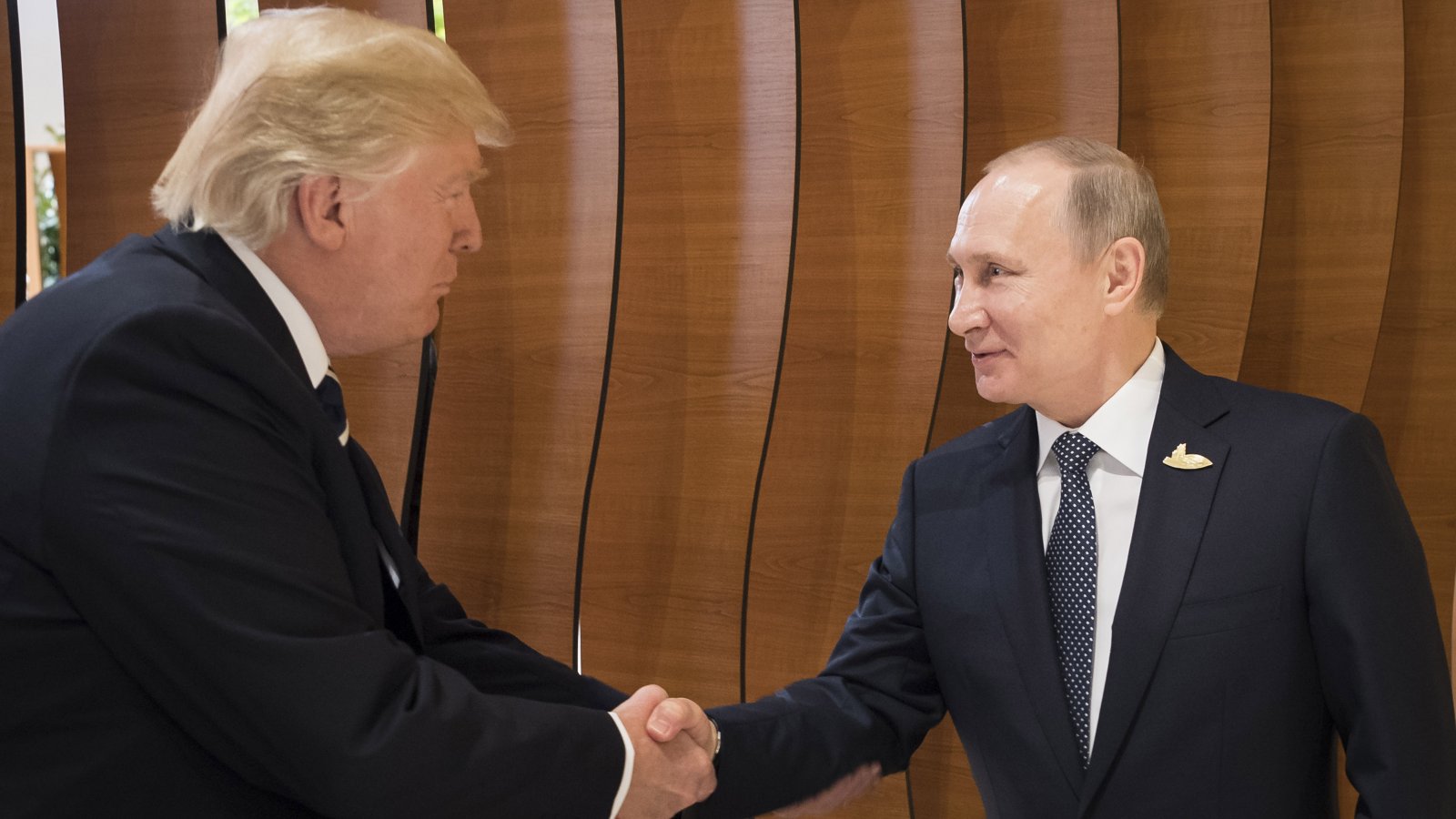
As President Trump plans to meet with Russian President Vladimir Putin in less than three weeks, foreign policy experts are concerned the U.S. president is not prepared – or not willing – to stand up to Putin and fear what he may give up in the moment.
NYT:
They worry that Mr. Trump will make the same kinds of concessions to Mr. Putin when they meet in Helsinki, Finland, on July 16 that he made to Mr. Kim in Singapore, tilting a relationship that has already swung in Russia’s favor.
In the past few weeks alone, Mr. Trump has called for Russia to be readmitted to the Group of 7 industrial powers, suggested it has a legitimate claim to Crimea because a lot of Russian speakers live there and continued sowing doubts about whether Moscow meddled in the 2016 presidential election — or if it did, whether the sabotage actually benefited Hillary Clinton.
(...)
It has become a recurring motif for Mr. Trump as a statesman: In November, he lavished praise on President Xi Jinping of China after a one-on-one meeting in Beijing, during which Mr. Xi offered no concrete concession on trade — an issue that matters more to Mr. Trump than almost any other.
What these three leaders have in common is that they are autocrats, whom Mr. Trump admires and believes he can win over with a brand of personal diplomacy that dispenses with briefing papers or talking points and relies instead on a combination of flattery, cajolery and improvisation.
“Trump sees a good meeting as a positive diplomatic achievement,” said Michael McFaul, a former American ambassador to Moscow. “That’s wrong. Good meetings are a means to an end.”
(...)
Mr. Trump argues that his personal relationships will ultimately yield results that have eluded his more conventional predecessors. In an interview with Fox News after the Singapore summit meeting, he said that if he could have dinner with Mr. Putin, he could persuade him to withdraw from Syria and stop preying on Ukraine.
“I could say: ‘Would you do me a favor? Would you get out of Syria?’” Mr. Trump said. “‘Would you do me a favor? Would you get out of the Ukraine?’”
(...)
Mr. McFaul predicted Mr. Putin would be a formidable counterpart in a one-on-one meeting, well briefed on American foreign policy and determined to use that knowledge to undermine the administration’s policies, especially on Ukraine.
Seasoned national security experts also worry about the Kremlin's ability to control the narrative around U.S.-Russia relations.
The month after Trump and Putin spoke in March, the Kremlin told reporters that it was during that conversation that Trump suggested the two should meet in Washington. Trump had told reporters after the phone call only that they discussed a possible meeting. The Russians’ revelation of a Washington meeting forced White House press secretary Sarah Huckabee Sanders to acknowledge that “a number of potential venues, including the White House,” were discussed.
In May 2017, an official Russian photographer was allowed into the Oval Office to take pictures of Trump, Foreign Minister Sergey Lavrov and the ambassador at the time, Sergey Kislyak, seemingly joking around. The photos were released by TASS even though U.S. news media were barred from the event. The White House did not release its own photographs of the event.
And after his Kremlin meetings on Wednesday to finalize the summit, Bolton gave a news conference at Interfax, the Russian news agency, rather than at the U.S. Embassy, which struck some as unusual for an American official in Moscow.
The Kremlin was first to report Trump and Putin’s Dec. 17 call, and a review of statements from both countries found that Russia’s accounts are generally more specific.
“I just don’t understand it, frankly,” Michael McFaul, the U.S. ambassador to Russia from 2012 to 2014, told POLITICO. “It’s pretty elementary how one does this.”
(...)
“Putin will definitely try to secure statements from the president that he thinks are in Russia’s interest,” McFaul said. “And he will not be afraid to read them out to the press. In fact, he won’t be afraid to read them out with Trump sitting right there.”
“Be careful what you say, because Putin will pocket it. And he’ll tell the world that,” he warned. “It would be hard for President Trump to say, ‘That’s not what we agreed to.’”
Secretary of State Mike Pompeo indicated to the Senate Appropriations Committee Wednesday he believes President Trump is clear on what is in the United States' best interest, even though on Thursday, the president again tweeted his disbelief Russia interfered in the 2016 election because Russia says so.
“The president deeply believes that having Russia be part of these important geo-strategic conversations is inevitable,” Pompeo told the committee in response to questions about Trump’s comments that Russia should be included in G-7 discussions. “There is a long history of that.”
(...)
“The president is looking forward to an opportunity to find those handful of places where we can have productive conversations that lead to improvements for each of our two countries,” he said. “Our eyes are wide open that that field space is pretty small, they don’t share our values in the same way that European countries do. But the president is hopeful that we can reduce the temperature, reduce the risk for America and find a handful of places where we can perhaps get a good outcome for Ukraine.”
(...)
The summit would offer Putin a chance to try to persuade Washington to lift some of the sanctions imposed on Russia over its annexation of Crimea, interference in eastern Ukraine’s separatist fighting and alleged meddling in the 2016 U.S. presidential election.
In Meeting With Putin, Experts Fear Trump Will Give More Than He Gets (NYT)
Ahead of summit, U.S. and Russia tussle to control the narrative (Politico)
US says Russia’s return to fold ‘inevitable’ as summit looms (AP)