
UPDATE 2: The New York Times takes a look at who amongst top Republicans was willing to take a stand on Trump's Mueller attacks and who kept quiet. Reporters reached out to Congressional leadership as well as the chairmen of the House and Senate Intelligence Committees, the chairmen of the House and Senate Judiciary Committees, and other prominent GOP lawmakers. The following had no comment:
Senator Mitch McConnell of Kentucky, the majority leader
Senator John Cornyn of Texas, the majority whip and a member of the Senate Intelligence Committee
Senator John Thune of South Dakota, the chairman of the Senate Republican Conference
Representative Kevin McCarthy of California, the majority leader
Senator Richard M. Burr of North Carolina, the chairman of the Senate Intelligence Committee
Senator Roy Blunt of Missouri
Senator Susan Collins of Maine
Senator Tom Cotton of Arkansas
Senator Jim Risch of Idaho
Representative Devin Nunes of California, the chairman of the House Intelligence Committee
Senator Charles E. Grassley of Iowa, the chairman of the Senate Judiciary Committee
Representative Robert W. Goodlatte of Virginia, the chairman of the House Judiciary Committee
Read more: How Top Republicans Reacted, or Didn’t, to Trump’s Tweets on Mueller (NYT)
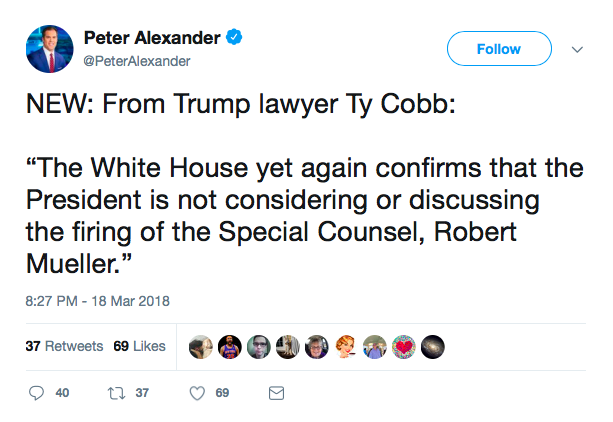
UPDATE: Sunday night statement from the White House:
Both Republicans and Democrats are insisting they will not stand for President Trump firing Robert Mueller without cause, but so far, nothing has been done to shield the special counsel should the president make that call.
Republican Senator Jeff Flake, who has criticized Trump harshly, said the president’s latest comments appeared to be aimed at the firing of Mueller. Senator Lindsey Graham, another Republican, said if Trump were to dismiss Mueller it would mark “the beginning of the end of his presidency.”
AshLee Strong, a spokeswoman for Republican House Speaker Paul Ryan, said: “As the speaker has always said, Mr. Mueller and his team should be able to do their job.”
The comments underscored the risks for Trump if he goes too far to thwart the federal probe.
“I don’t know what the designs are on Mueller, but it seems to be building toward that (firing him), and I just hope it doesn’t go there, because it can’t. We can’t in Congress accept that,” Flake told CNN’s “State of the Union.”
“So I would expect to see considerable pushback in the next couple of days urging the president not to go there.”
(...)
Graham, a co-author of legislation that would make it harder for a president to fire a special counsel, said it was very important that Mueller be allowed to proceed without interference and that many Republicans share this view.
“The only reason Mr. Mueller could ever be dismissed is for cause. I see no cause when it comes to Mr. Mueller,” Graham said on CNN.
Another Republican, Senator James Lankford, said he does not believe Trump would fire Mueller.
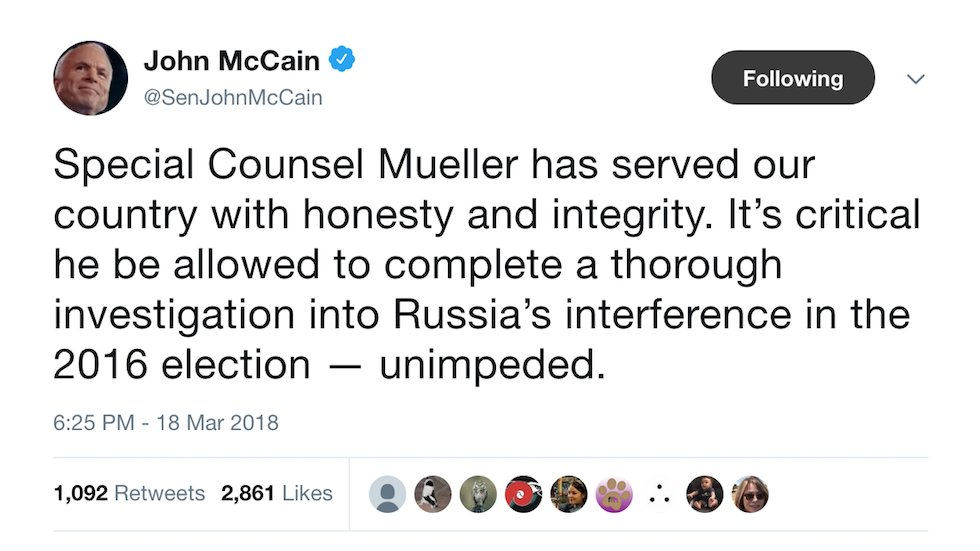
Senator John McCain (R-AZ) tweeted his stance on the issue.
However, legislation to protect Mueller has stalled in Congress, with Republicans saying at the end of January they saw no immediate threat or urgent need to pass a bill.
Democrats, meanwhile, say the time to do something is now – before the president makes a move.
Rep. Adam Schiff of California was responding to a question from ABC News Chief Anchor George Stephanopoulos on "This Week" Sunday. “What would happen if the president” fired special counsel Robert Mueller? Stephanopoulos asked.
Schiff said, “I would hope that it would prompt all Democrats and Republicans in the House to pass an independent-counsel law and reinstate Bob Mueller. This would undoubtedly result in a constitutional crisis, and I think Democrats and Republicans need to speak out about this right now.”
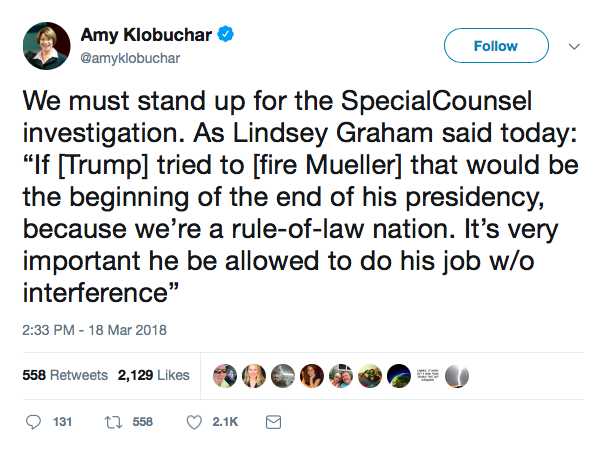
Senator Amy Klobuchar (D-MN), a member of the Senate Judiciary Committee, spoke up on Twitter.
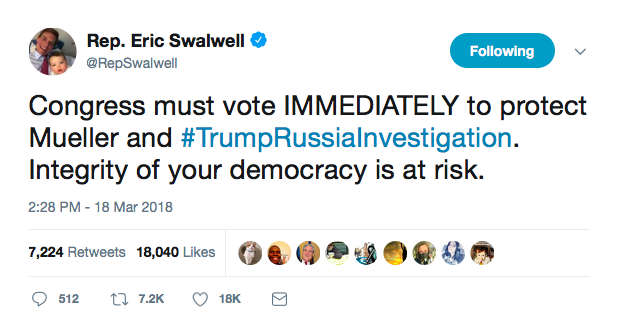
Rep. Eric Swalwell (D-CA), who sits on the House Intelligence Committee with Rep. Schiff, tweeted too.
In an op-ed for USA Today, Senator Mark Warner (D-VA), Vice Chairman of the Senate Intelligence Committee, lays out all the ways the president and his allies have attacked federal law enforcement and attempted to derail the Russia investigation and explains why Congress must be willing to protect democracy and the rule of law.
Mr. Mueller is a Vietnam War veteran and a lifelong Republican, with impeccable credentials as a man of the law. He has assembled a team that includes some of the nation’s best investigators and prosecutors, and he has led this investigation with the professionalism that a task of this importance requires.
The truth is that Russia attacked us right here at home — not with guns or missiles but through cyber raids and a broad disinformation campaign aimed at undermining our democratic process. Ignoring and politicizing this ongoing threat to our national security will not make it go away.
That’s why we must draw a red line.
Passing legislation to protect the Mueller probe is a necessary start, but our nation’s elected officials must also summon the courage to challenge those in our ranks who would put partisan politics over truth, or who would put the president’s interests over the interests of justice.
Congress must make clear to the president that firing the special counsel, or interfering with his investigation by issuing pardons of essential witnesses, is unacceptable and would have immediate and significant consequences.
In the United States of America, no one is above the law. Not even the president.
Republicans Show Little Urgency on Legislation to Protect Mueller (NYT)
Republicans to Trump: Let Mueller do his job (Reuters)
Congress must draw 'red line' to protect Mueller, warn Trump against firing and pardons: Mark Warner (USA Today)