
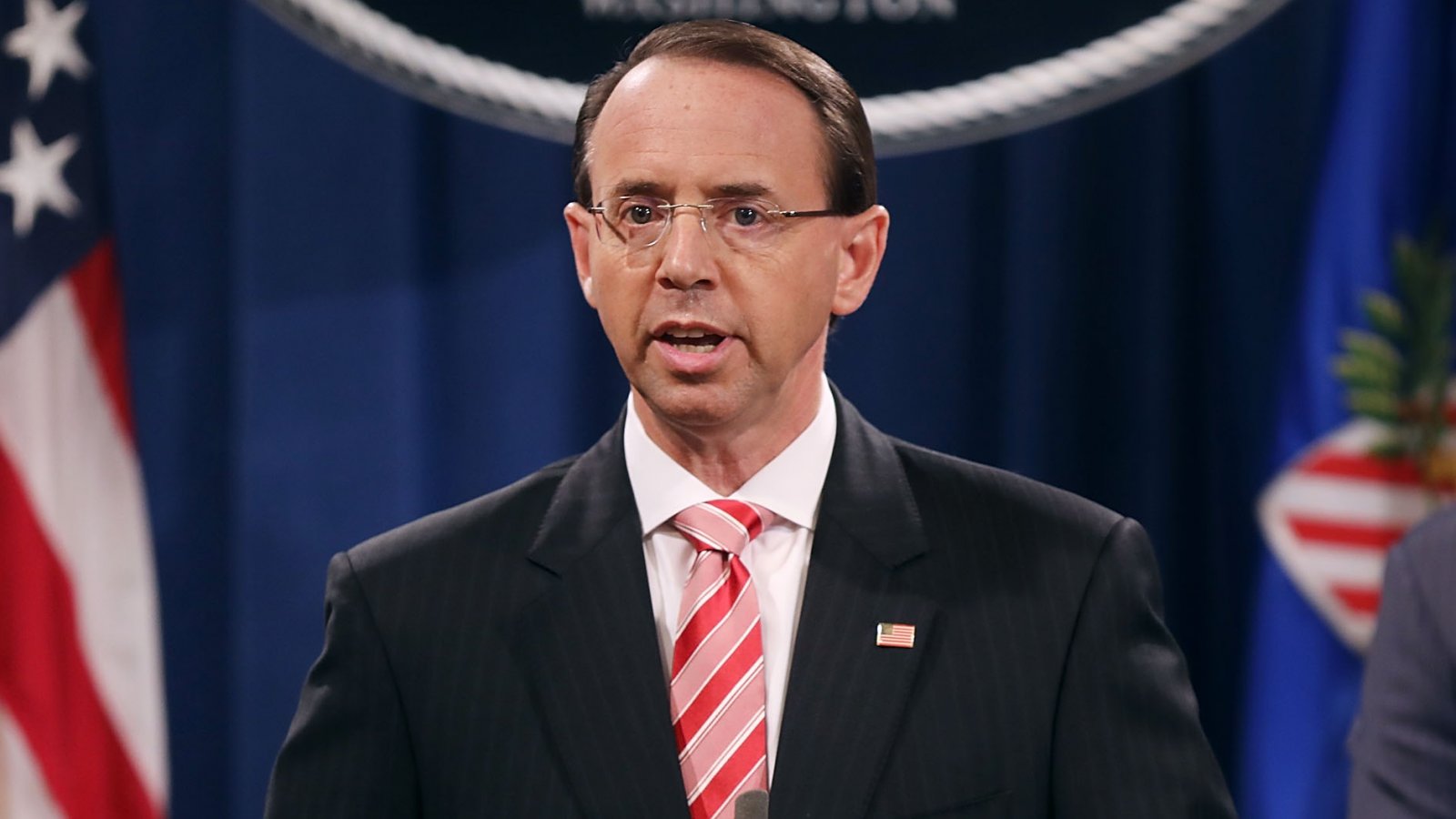
Deputy Attorney General Rod Rosenstein used his appearance at the Aspen Security Forum Thursday to unveil a new report detailing how the Justice Department plans to respond to future cyber attacks and election security threats.
WaPo:
The government will inform American companies, private organizations and individuals that they are being covertly attacked by foreign actors attempting to affect elections or the political process.
“Exposing schemes to the public is an important way to neutralize them,” said Deputy Attorney General Rod J. Rosenstein, who announced the policy at the Aspen Security Forum in Colorado. Rosenstein, who has drawn President Trump’s ire for appointing a special counsel to probe Russian election interference, got a standing ovation.“The American people have a right to know if foreign governments are targeting them with propaganda,” he said.
(...)
“If this disclosure requirement had been around in 2016, I firmly believe that it would have served as a meaningful deterrent after Russia’s interference was first discovered, and it would have informed voters more quickly and more forcefully that a foreign government was trying to affect their vote,” said Rep. Adam B. Schiff (D-Calif.), who two years ago pressed the Obama administration to call out Russia’s activities.
Rosenstein said the Russian effort to influence the 2016 election “is just one tree in a growing forest. Focusing merely on a single election misses the point.”
(...)
The policy, which is part of a report issued on a new Cyber Digital Task Force, set up by Attorney General Jeff Sessions in February, also specifies that in considering whether to disclose information, the department must protect intelligence sources and methods, investigations and other government operations.
“Partisan political considerations must play no role in efforts to alert victims, other affected individuals or the American public to foreign influence operations against the United States,” the policy states. A foreign influence operation will be publicly disclosed “only when the government can attribute those activities to a foreign government with high confidence,” it said.
(...)
The new task force for the first time spelled out five types of threats covered under foreign influence operations.
Hackers can target election systems, trying to get into voter registration databases and voting machines. Foreign operatives can pursue political organizations, campaigns and public officials. They can offer to assist political organizations or campaigns, while concealing their links to foreign governments. They can seek to covertly influence public opinion and sow division through the use of social media and other outlets. And they can try to employ lobbyists, foreign media outlets and other foreign organizations to influence policymakers and the public.
“Public attribution of foreign influence operations can help to counter and mitigate the harm caused by foreign-government-sponsored disinformation,” Rosenstein said. “When people are aware of the true sponsor, they can make better-informed decisions.”
(...)
To counter foreign influence, the department will aggressively investigate and prosecute such activities, and will work with other departments, such as Homeland Security, to share information about threats and vulnerabilities with state and local election officials, political organizations and other potential victims so they can take measures to detect or prevent harm, the report said.
The report also describes a range of challenges hampering the government’s ability to fight more traditional cybercrime and recommends possible solutions.
The challenge that receives the most attention is encryption and other technological impediments to accessing investigative data. The spread of easy-to-use, often-invisible encryption “poses a significant impediment to the investigation of most types of criminal activity,” the report warns.
For years, the government has urged tech companies to voluntarily use warrant-compatible encryption, but in recent years Silicon Valley has moved in the opposite direction. The report recommends seven ways for DOJ to respond to this problem, including “considering whether legislation to address encryption (and all related service provider access) challenges should be pursued.”
(...)
Another problem relevant to election security is that the Computer Fraud and Abuse Act only empowers DOJ to prosecute people who hack internet-connected devices.
“In many conceivable situations, electronic voting machines will not meet those criteria, as they are typically kept off the Internet,” the report notes. “Consequently, should hacking of a voting machine occur, the government would not, in many conceivable circumstances, be able to use the CFAA to prosecute the hackers.”
At the Aspen event, Rosenstein said the report underscored how DOJ “must continually adapt criminal justice and intelligence tools to combat hackers and other cybercriminals.”
The DOJ began compiling the report in February, after Attorney General Jeff Sessions, under fire from congressional Democrats for not appearing to prioritize election security, created a Cyber-Digital Task Force to study DOJ-related cyber issues and “identify how federal law enforcement can more effectively accomplish its mission in this vital and evolving area.”
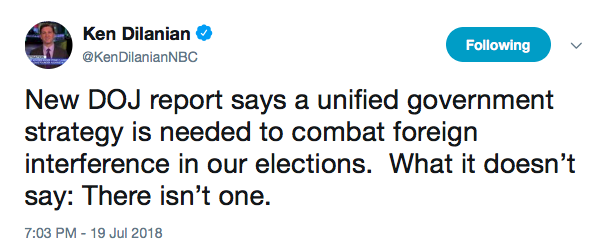
But in spite of all this information, NBC's Ken Dilanian notes a coordinated, whole-of-government plan is still missing.
Justice Department unveils strategy to fight election meddling, cybercrime (Politico)
Justice Department plans to alert public to foreign operations targeting U.S. democracy (WaPo)