UPDATE: The Washington Post explains that Putin was sending the world a message by giving former German chancellor Gerhard Schröder a high profile spot at his inauguration.
It was a remarkable and revealing moment. At Russia’s biggest political event of the year, just two days before the country celebrates the Soviet World War II victory over the Nazis, a front-row spot of the utmost honor was granted to a former German leader.
Schröder’s placement, captured repeatedly by state TV cameras and broadcast on the evening news, showed the depth of the ties between Putin and his perhaps most important foreign friend. It served as a reminder that the former East Germany-based KGB officer who now rules Russia continues to look to Berlin as his key bridge to Europe. And it looked to be an effort to show Russians — and the West — that the Kremlin still has allies abroad despite sanctions and criticism.
“This was a signal that those who take a positive position in relation to the Kremlin will be supported by it,” said Alexey Chesnakov, a former Kremlin adviser turned pro-Putin commentator.
(...)
Schröder's visit came as Western governments, including Germany's, have been criticizing Russia over the arrest of more than 1,600 protesters who participated in anti-Putin rallies Saturday.
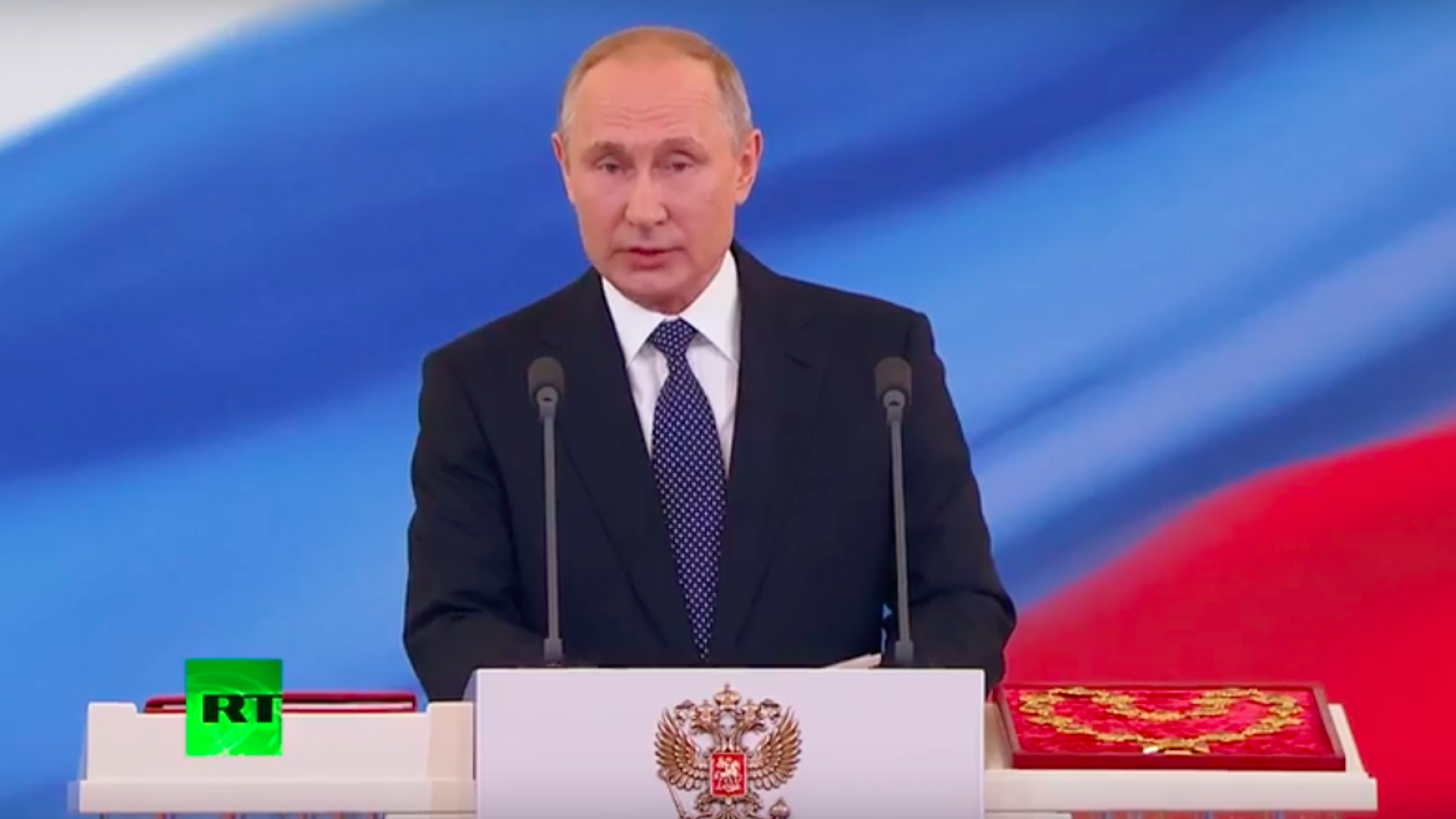
Russian President Vladimir Putin was sworn in on Monday for his fourth six-year term.
In a ceremony in an ornate Kremlin hall in Moscow, Putin said improving Russia’s economy following a recession partly linked to international sanctions would be a primary goal of his next six-year term.
“Now, we must use all existing possibilities, first of all for resolving internal urgent tasks of development, for economic and technological breakthroughs, for raising competitiveness in those spheres that determine the future,” he told thousands of guests standing in the elaborate Andreevsky Hall of the Grand Kremlin Palace and two adjacent halls.
(...)
Although Putin has restored Russia’s prominence on the world stage through military actions — including intervening in Syria’s war to help President Bashar Assad — he has been criticized for inadequate efforts to diversify Russia’s economy away from its dependence on oil and gas exports or develop the country’s manufacturing sector.
Russia’s economy was hit hard by low world oil prices and sanctions connected to Russia’s 2014 annexation of Crimea and military involvement in the separatist uprising in eastern Ukraine, with the ruble losing half its value between 2014 and 2016.
The country recorded an anemic improvement in 2017, with gross domestic product rising 1.5 percent and the ruble recovering some of its value. But the ruble dropped about 8 percent again last month in the wake of new U.S. sanctions.
(...)
Putin has effectively been the leader of Russia for all of the 21st century. He stepped down from the presidency in 2008 because of term limits, but was named prime minister and continued to steer the country until he returned as president in 2012.
Putin was applauded by about 5,000 guests as he entered the palace’s ornately decorated Andreyevsky Hall through colossal doors flanked by Kremlin guards. Among the guests were Gerhard Schröder, the former German chancellor, Steven Seagal, the former Hollywood action star who has become close to Russia’s political elite, and Alexander Zaldostanov, the leather-clad, tattooed leader of a pro-Putin motorcycle club.
With his hand on a gold-embossed copy of the Russian constitution, Putin swore to serve the Russian people faithfully. He also hailed Moscow’s ability to stand up for it interests in the international arena, and what he called Russia’s traditional values.
(...)
Monday’s inauguration ceremony came just two days after Russian security forces assisted by Cossack fighters detained hundreds of people, including the opposition leader Alexei Navalny, at an anti-Putin protest in central Moscow. The EU condemned “police brutality and mass arrests”, and human rights figures demanded an investigation into why Cossacks had been allowed to attack opposition supporters, including with leather whips. Russian opposition media said on Sunday that Moscow city hall has paid a pro-Kremlin Cossack organisation almost £190,000 to ensure public order in the Russian capital.
Soon after the ceremony, Putin issued an order formally dissolving the Cabinet but nominated [Prime Minister Dmitry] Medvedev to serve again as prime minister. The lower house of parliament is to vote on whether to approve him on Tuesday.
AFP:
"Putin submitted Dmitry Medvedev's candidacy to receive the agreement of the State Duma to appoint him prime minister," the Kremlin said in a statement shortly after Putin was inaugurated for a fourth term.
Medvedev, now 52, served as president from 2008 to 2012 when Putin had served the maximum two consecutive terms permitted by the Russian constitution.
Putin then returned as president in 2012 while Medvedev became prime minister in a deal that the men said they had long agreed, disappointing those who had seen Medvedev as a more liberal figure and prompting mass street protests led by opposition politician Alexei Navalny.
Russia’s Putin sworn in for 4th term; vows economic reforms (AP)
Vladimir Putin sworn in for fourth term in Kremlin ceremony (The Guardian)