
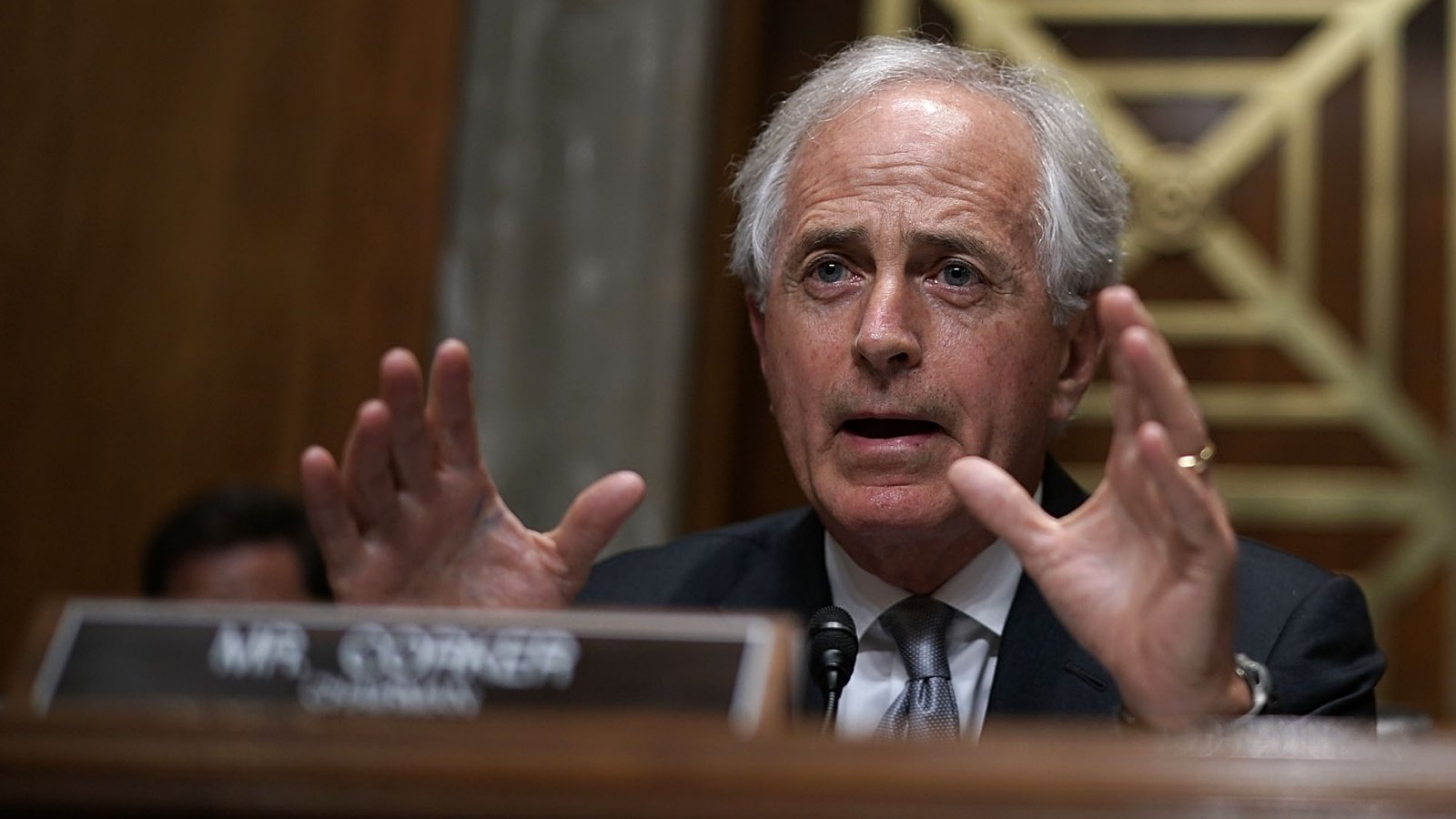
The Senate Foreign Relations Committee held an open hearing on US-Russia relations Tuesday morning.
CNN's national security reporter:
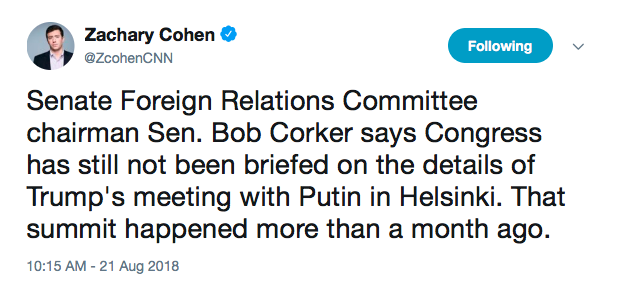
The two witnesses were the State Department's Bureau of European and Eurasian Affairs Assistant Secretary Wess Mitchell and the Treasury Department's Terrorist Financing Assistant Secretary Marshall Billingslea.
Mitchell's prepared remarks are here.
Billingslea's prepared remarks are here.
At the same time, the Senate Banking Committee held a similar hearing entitled, "Russia Sanctions: Current Effectiveness and Potential for Next Steps."
The witnesses [were]: The Honorable Sigal P. Mandelker, Under Secretary of Terrorism and Financial Crimes and Deputy Secretary (Acting), United States Department of the Treasury; The Honorable Christopher Krebs, Under Secretary for the National Protection and Programs Directorate, United States Department of Homeland Security; and, The Honorable Manisha Singh, Assistant Secretary, Bureau of Economic and Business Affairs, United States Department of State.
Senators are looking for a way to keep the pressure on the Russian government to deter ongoing aggression while not inflicting unnecessary pain on the Russian people, European allies, or global markets.
Both Republicans and Democrats in Congress have called for tough measures against Russia after President Donald Trump was seen as too conciliatory toward Russian President Vladimir Putin at their summit last month in Helsinki.
(...)
Many of the sanctions that have been imposed on Russia have been required by new or long-standing legislation passed by Congress, such as the State Department’s move this month to punish Putin’s government for the nerve-agent attack on a former spy and his daughter in the U.K.
[Dan] Coats, the intelligence chief, warned this month that Russians are only a “keyboard click” away from interfering in this year’s election, saying they “are looking for every opportunity, regardless of party” to disrupt the process.
(...)
[Senator Chris] Van Hollen (D-MD) [who introduced a new sanctions bill with Senator Marco Rubio (R-FL) in January] said the final legislation could include two tranches of sanctions -- one that would be automatic and can’t be waived by the administration, and a second set that could be waived for national security reasons, giving Trump more flexibility.
Shadowing the negotiations is uncertainty over whether Trump would veto a measure forcing him to impose far-reaching new sanctions -- and whether the Republican-led Congress has any appetite for overriding such a veto.
Van Hollen said he’s hopeful the bill can attract large majorities in Congress, as did Russia sanctions that lawmakers approved last year.
Corker said that he and Banking Chairman Mike Crapo of Idaho are working closely and trying to craft a process that produces legislation that’s “so overwhelmingly supported that the White House wouldn’t even consider vetoing it.”
... Corker (R-Tenn.) emphasized that lawmakers should continue to put a focus on Russia's election meddling.
“There is no question whatsoever that Russia is involved in trying to create disunity in our country,” Corker told reporters shortly after concluding the first of several hearings on U.S.-Russia relations.
“[The Russians] are winning when we are having this conversation … this is a threat to our nations, our nation has become increasingly distrustful,” Corker said. “We’ve got to counter that.”
Sen. Bob Menendez (N.J.), the top Democrat on the Foreign Relations panel, said senators will hear from the administration on Wednesday “to understand what it is that in fact [the Russians] are doing, but it doesn’t seem to me we have deterred Russian aggression.”
Russia Sanctions Bill Tweaks in Senate May Curb Spillover Risks (Bloomberg Politics)
Rubio: Top US political groups should expect Russian cyberattacks (The Hill)