
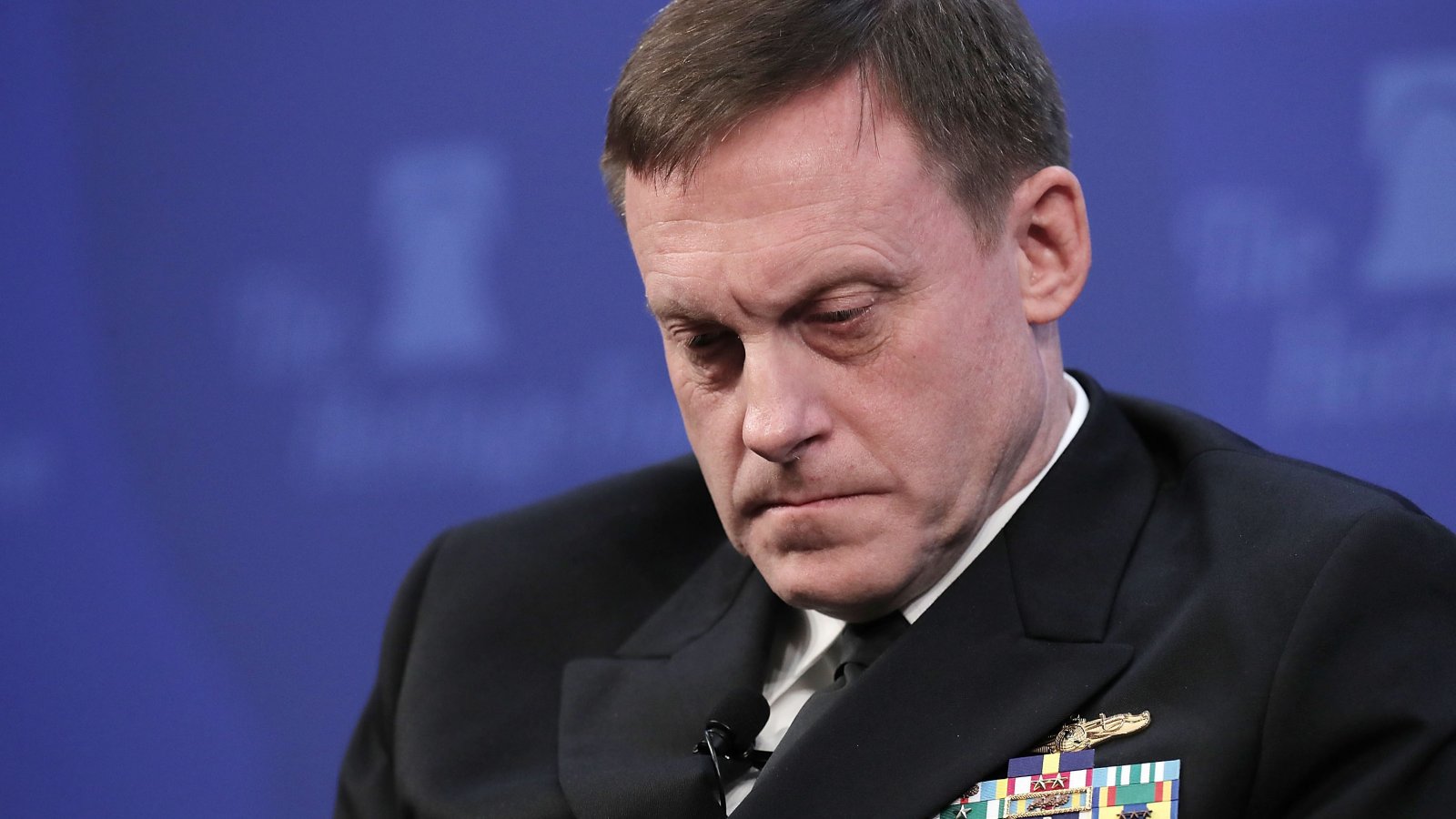
NSA Director Admiral Mike Rogers, in testimony before the Senate Armed Services Committee Tuesday, admitted President Trump has not given him any instruction to take action against Russia for past and ongoing cyberattacks on the United States.
CNN:
Asked by Democratic Sen. Jack Reed if he has been directed by the President, through the defense secretary, to confront Russian cyber operators, Rogers said "no I have not" but noted that he has tried to work within the authority he maintains as a commander.
While he did not agree with Reed's characterization that the US has been "sitting back and waiting," Rogers admitted that it is fair to say that "we have not opted to engage in some of the same behaviors we are seeing" with regards to Russia.
"It has not changed the calculus or the behavior on behalf of the Russians," Rogers said about the US response to Russia's cyber threat to date.
"They have not paid a price that is sufficient to change their behavior," he added.
While Rogers said he has not asked for additional authorities to stop Russian cyberattacks at the source, he noted that it would ultimately be up to President Trump to give him that permission.
“I need a policy decision that indicates there is specific direction to do that,” Rogers said. “The president ultimately would make this decision in accordance with a recommendation from the secretary of Defense.”
(...)
Rogers was grilled by lawmakers from both parties about the steps the government has taken to deter and respond to Russian efforts to disrupt American elections throughout the hearing, which was scheduled to examine the fiscal year 2019 budget request for U.S. Cyber Command.
(...)
The Department of Homeland Security responded to Russian hacking by providing state and local election officials with cyber testing and other resources to help protect their systems from future cyberattacks.
Adm. Rogers is wrapping up his tenure as NSA Director, retiring this spring. President Trump has nominated Lt. Gen. Paul Nakasone to replace him.
Nakasone, 54, has been the chief of Army Cyber Command since late 2016. In that role, he also directed Joint Task Force Ares, a special unit that develops digital weapons to attack and disrupt the Islamic State's online operations.
Prior to that, Nakasone served at Cyber Command, where he oversaw the units tasked with defending the country's digital networks and information systems, collectively known as the Cyber National Mission Force.
He also twice worked as a staff officer to the Joint Chiefs of Staff. And, as a colonel, Nakasone served as a staff officer to Gen. Keith Alexander, who led the NSA from 2005 to 2014 and was the first head of Cyber Command.
Widely respected through the cybersecurity and military communities, Nakasone will have to draw on his breadth of experience to shepherd NSA and Cyber Command at a pivotal time.
NSA chief says Trump hasn't told him to confront Russian cyber threat (CNN)
Trump taps Army cyber chief as next NSA head (Politico)