
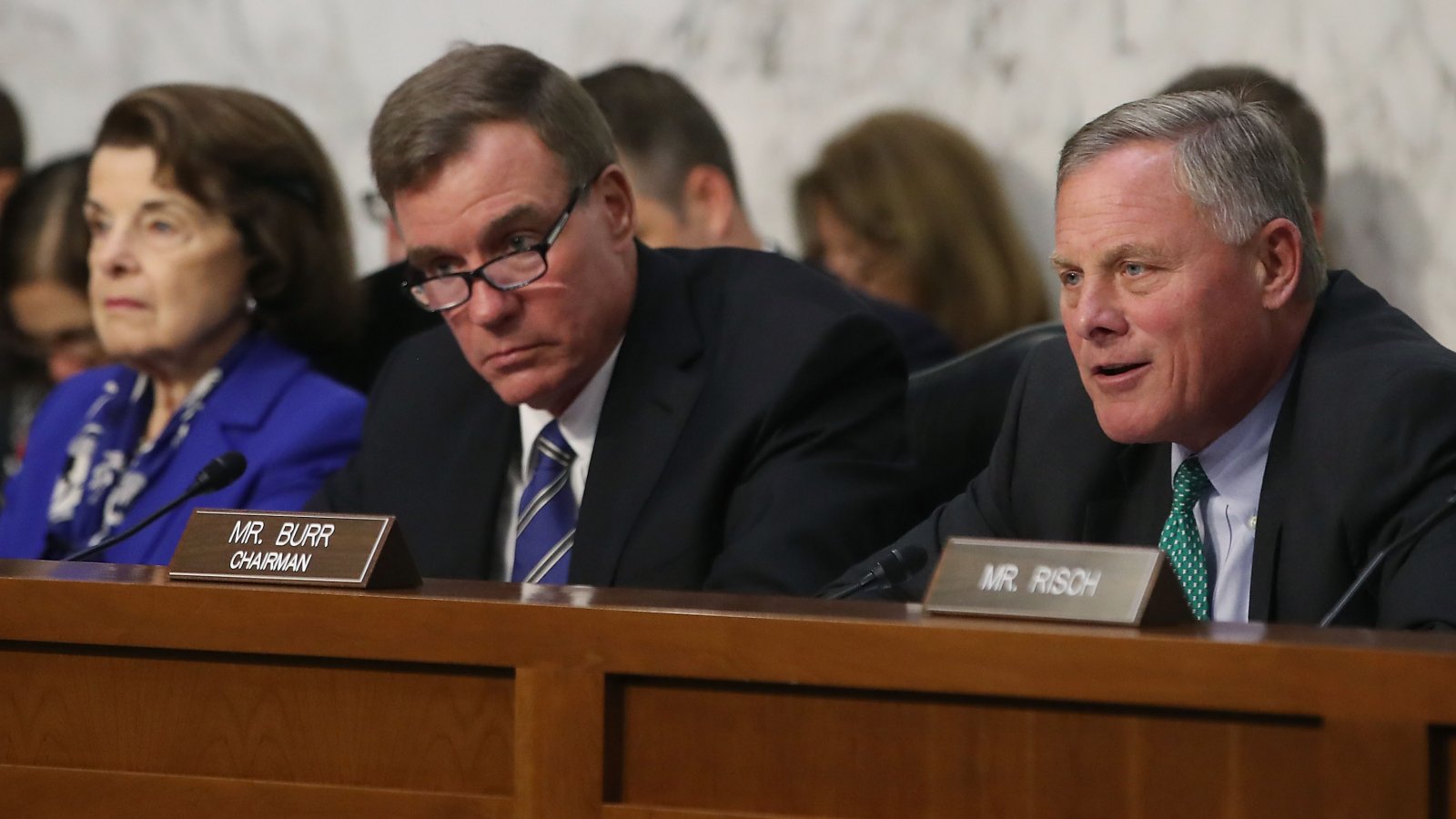
The Senate Intelligence Committee heard from social media and technology experts Wednesday in an open hearing to explore what more can be done to stop and counter foreign election interference. The main takeaway is that Russia and other foreign actors still are actively spreading disinformation and propaganda, and technology companies are not doing enough to stop them.
The challenge, said Sen. Mark Warner, D-Va., vice chairman of the committee, is to figure out how to crack down on misinformation campaigns without infringing on civil liberties and free speech.
"Foreign operatives … almost by design slip between our free speech guarantees and our legal authorities," Warner said.
It was the committee’s third official hearing focusing on social media and foreign influence, though there have been more than a dozen hearings touching on the topic, according to a spokesperson for Warner.
(...)
Central to the hearing was the idea that Russia exploited the hesitance of tech companies to regulate what is posted on their platforms. Tech companies are not legally liable for what people post because of the Communications Decency Act of 1996, Section 230 of which states that online platforms have “safe harbor” from liability because they are considered pipes for the distribution of information under the law, not publishers themselves.
(...)
Sen. Ron Wyden, D-Ore., who helped create that standard, had stern words for tech companies that rely on that legal protection.
“As the author of Section 230, the days when these pipes are considered neutral are over,” Wyden said, “because the whole point of 230 was to have a shield and a sword, and the sword hasn’t been used and these pipes are not neutral.”
Witnesses did not mince words when explaining to Senators the urgency of finding solutions.
“This is one of the defining threats of our generation,” said Renee DiResta, director of research at New Knowledge, a company that identifies social media disinformation. “Platforms need to be held accountable for private ownership of our public squares.”
It’s likely that attacks by Russia and other foreign powers will only get more devious and harder to detect, using more deceptive methods (like sockpuppets, false online identities designed to deceive), witting and unwitting participants, smaller platforms, artificial intelligence, and fake audio and video, DiRestra said.
(...)
Laura Rosenberger, director of the Alliance for Securing Democracy at the German Marshall Fund, an international policy think tank, suggested that platforms could authenticate their users while using technical or third-party tools to protect user privacy and anonymity.
She also said that while the platforms may not have seen or expected the attacks in 2016, they no longer had any excuse for not taking action.
“What was once a failure to imagine is a failure to act,” said Rosenberger.
Philip Howard, director of the Oxford Internet Institute, said platforms need to be more open with sharing data on what goes on while still protecting user privacy.
“It’s the social media firms that have the best access to the information” about what happens on them, Howard said.
Lawmakers at the hearing called attention to the Honest Ads Act, a measure to regulate digital political ads, as one potential way to address social media manipulation. Committee members, however, refrained from pushing other concrete solutions for addressing the matter.
Still, Committee Chairman Richard Burr (R-N.C.) said he was confident this could change in the near future.
"I’m optimistic that we're started on that pathway to a solution," he said.
The Senate Intelligence Committee will hear from top executives from Facebook, Twitter, and Google in September.
Senate intel committee grapples with social media's threat to democracy (NBC News)
Lawmakers warn that social media manipulation is 'bigger than a single election' (The Hill)