
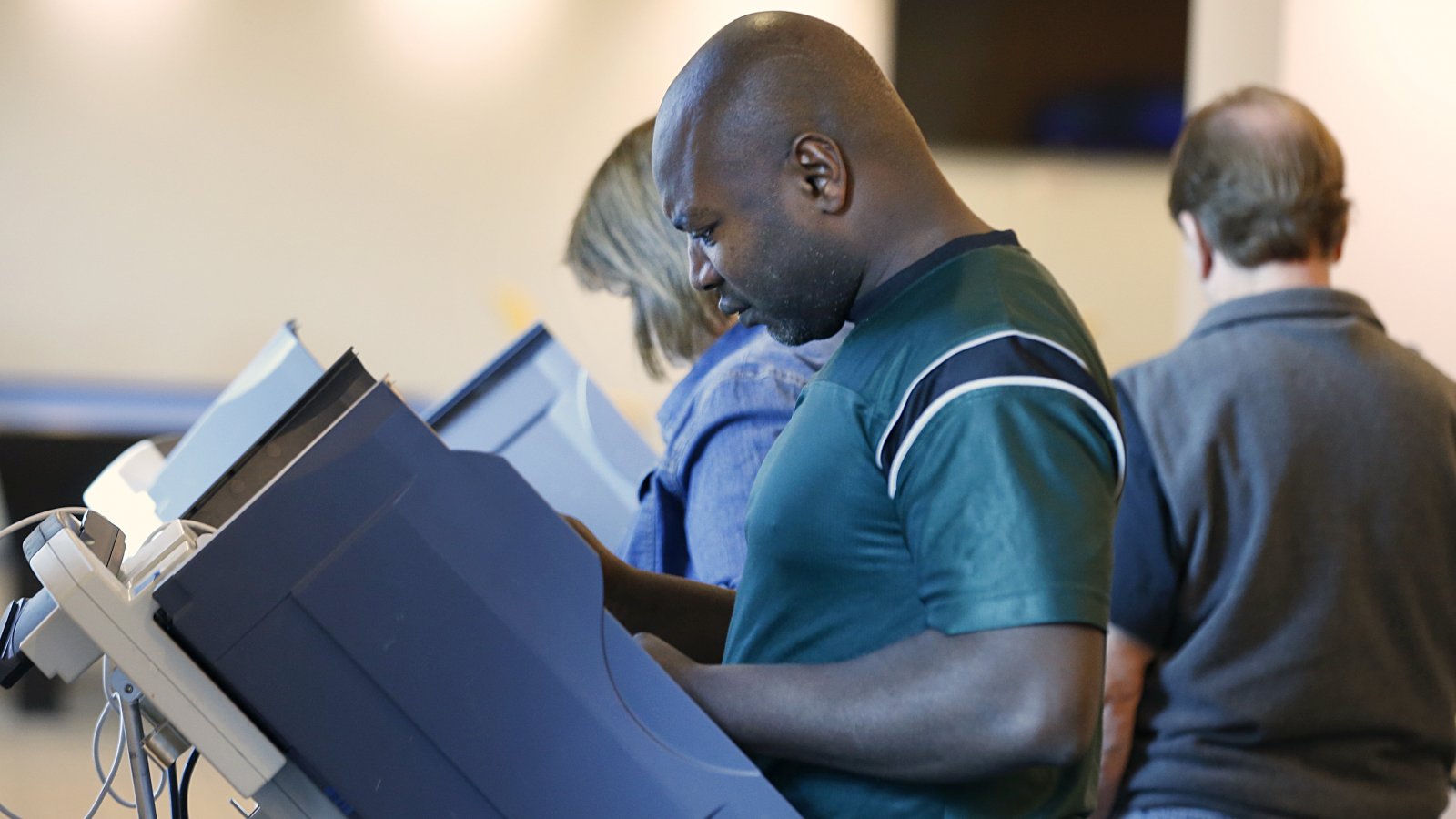
Democrats want to give the states more money to upgrade voting systems and better protect against future election attacks, but Republicans have voted down the funds in both the House and the Senate.
Senators voted 50-47 against adding an amendment from Sen. Patrick Leahy (D-Vt.) that would have provided the funding. Sixty votes were needed to include the proposal in the appropriations legislation under Senate rules.
Sen. Bob Corker (R-Tenn.) was the only GOP senator who voted in support of the amendment to an appropriations measure.
The proposal, spearheaded by Leahy, would have provided $250 million for state election security grants.
Republicans argue more funding isn't needed and that states haven't yet spent the $380 million previously approved by Congress.
AP:
Leahy said securing U.S. elections and "safeguarding our democracy" is not a partisan issue.
He said the Senate "must send a clear message to Russia and other foreign adversaries that tampering in our elections will not be tolerated. The president will not act. This duty has fallen to us."
A similar effort was also rejected in the House. Republicans said new money was not needed so soon after Congress approved $380 million in March for the state grant program.
Both Republicans and Democrats have criticized the administration's response as fragmented, without enough coordination across federal agencies. And with the midterms just three months away, critics are calling on President Donald Trump to take a stronger stand on an issue critical to American democracy.
"There's clearly not enough leadership from the top. This is a moment to move," said Maryland Sen. Chris Van Hollen, head of the Democratic Senatorial Campaign Committee. "I don't think they are doing nearly enough."
CNN:
"We have to take every action to protect our democracy. The Trump administration is not doing enough," he said, adding, "the Senate has to act."
The Democratic senator urged support for legislation he has introduced along with Florida Republican Sen. Marco Rubio that would impose sanctions on Russia if the US determines that the Kremlin has interfered in an American election.
The legislation "would tell Putin if he gets caught interfering in the 2018 elections, or elections going forward, he will face immediate, harsh penalties," Van Hollen said.
The administration did issue a statement after Facebook revealed Tuesday it had identified and removed 32 fake accounts and pages that were creating and spreading divisive propaganda ahead of the midterms. That statement made no mention of Russia.
Several hours after Facebook's announcement on Tuesday, National Security Council spokesman Garrett Marquis said in a statement: "We applaud efforts by our private sector partners to combat an array of threats that occur in cyberspace, including malign influence."
Marquis added that the NSC "leads the regular and continuous coordination of the whole-of-government approach to addressing foreign malign influence and ensuring election security."
[I]n the nearly two years since Russians were found to have hacked into U.S. election systems and manipulated social media to influence public opinion, the White House has held two meetings on election security.
One was last week. It ran 30 minutes.
The meeting resulted in no new presidential directive to coordinate the federal effort to secure the election, said Suzanne Spaulding, former undersecretary of homeland security who was responsible for cybersecurity and protecting critical infrastructure.
The Latest: Senate rejects new money for election security (AP)
Senate rejects effort to beef up states' election security spending (The Hill)
White House quiet on Russia after Facebook axes propaganda pages (Politico)
Democratic senator: 'I don't think the US government is doing enough' to fight Russian interference (CNN)
Trump criticized for not leading effort to secure elections (AP)