
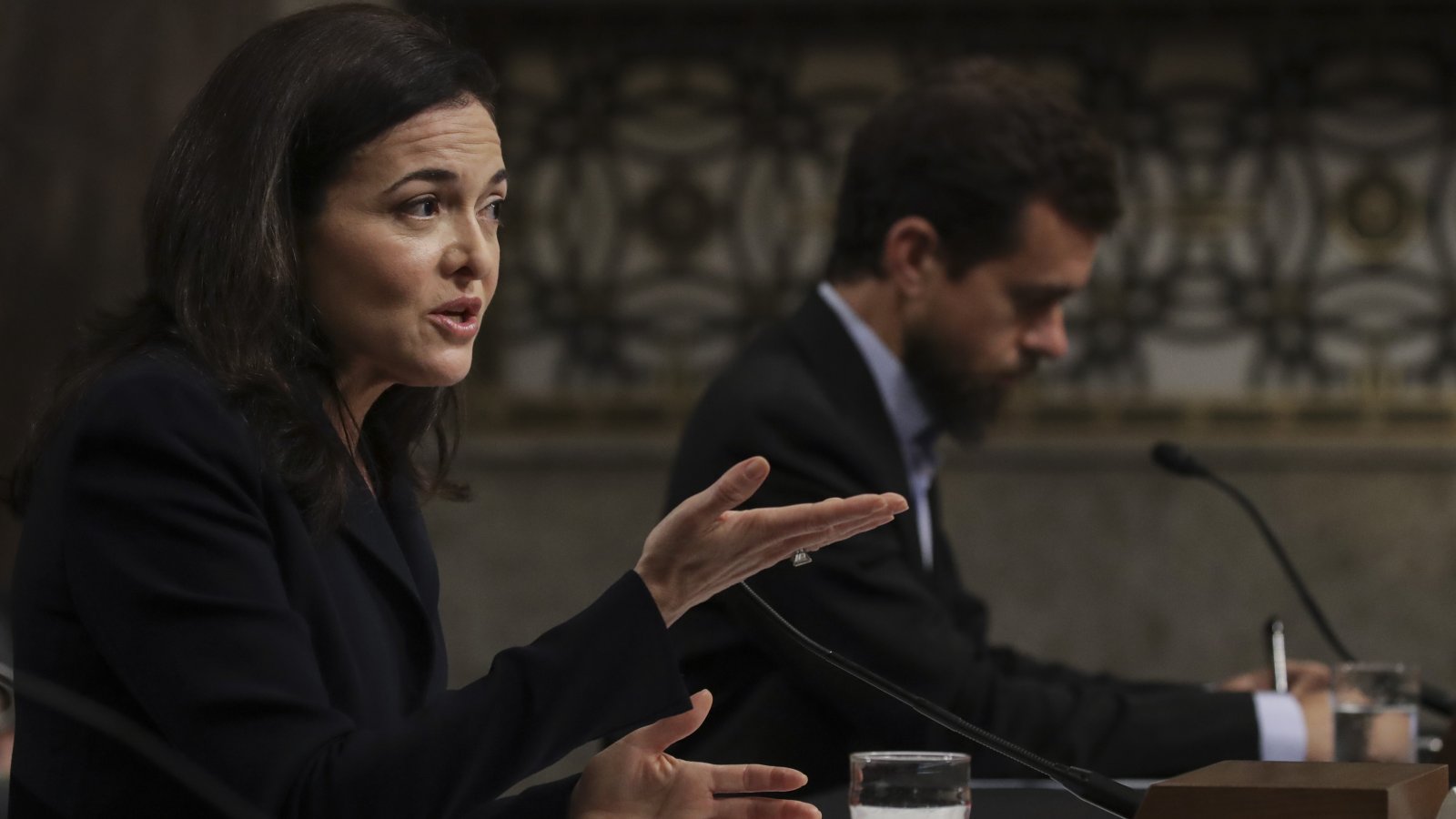
Facebook COO Sheryl Sandberg and Twitter Co-Founder and CEO Jack Dorsey appeared before the Senate Intelligence Committee Wednesday to answer questions about what their companies have been doing since the 2016 election to combat further interference and stop malicious foreign actors from using their platforms to spread of disinformation and propaganda.
At the start of the hearing Senator Mark Warner, the committee’s Democratic vice chairman, said the companies were not doing enough to stop the flow of foreign influence and threatened Congressional action.
(...)
“Unfortunately, what I described as a ‘national security vulnerability,’ and ‘unacceptable risk,’ back in November remains unaddressed,” Senator Richard Burr, the committee’s Republican chairman, said.
“Clearly, this problem is not going away. I’m not even sure it’s trending in the right direction,” he added.
Warner said social media companies were doing better at combating disinformation, but their efforts were insufficient.
“I’m skeptical that, ultimately, you’ll be able to truly address this challenge on your own. Congress is going to have to take action here,” Warner said.
"We were too slow to spot this and too slow to act. That's on us," Sandberg said. "This interference was completely unacceptable. It violated the values of our company and of the country we love."
Sandberg added: "We are more determined than our opponents and we will keep fighting."
Dorsey, meanwhile, stressed to lawmakers: “We found ourselves unprepared and ill-equipped for the immensity of the problems we've acknowledged. Abuse, harassment, troll armies, propaganda through bots and human coordination, disinformation campaigns and divisive filter bubbles -- that's not a healthy public square."
... [A]fter being pilloried for months, Ms. Sandberg and Mr. Dorsey learned that simply showing up and engaging more with Congress in recent months has vastly improved relations in Washington ...
Not all the tech companies were treated as well. Google, which had declined an invitation to send Larry Page, the chief executive of parent company Alphabet, to appear alongside the other tech executives prompted ire from lawmakers. An empty chair was placed at the witness table to intentionally draw attention to Google’s absence.
“To the invisible witness, good morning to you,” Senator Kamala Harris, a Democrat of California, said.
Several lawmakers were even harsher. Senator Marco Rubio, a Republican of Florida, said Google may not have shown up “because they are arrogant.” He added that Google executives may have wanted to dodge questions over a recent report of a consumer watchdog group posing as a Russian troll farm that tried to buy ads on Google.
NPR:
The past six months have been eventful as social media companies and tech giants have repeatedly announced the disruption of various influence operations.
In late July, Facebook announced that it had removed 32 accounts involved in a political influence campaign with links to the Russian government.
Microsoft said it discovered and stopped an attempted cyberattack tied to Russia.
Then Facebook made another announcement: It had shut down hundreds of accounts linked to an Iranian-backed global disinformation campaign. Twitter then followed suit by deleting accounts linked to this Iranian campaign.
Republican Senator Susan Collins said she had learned from a university report that she had been targeted some 270 times by Russian-linked tolls on Twitter, asking Dorsey why the company does not tell users when they have been attacked.
Dorsey said it was “unacceptable” that she was not told.
(...)
Conspiracy theorist Alex Jones held a press conference outside the Senate hearing room as the testimony began to criticize the social media companies for banning him and his website Infowars from their platforms.
Twitter’s Dorsey was to follow his Senate testimony with an appearance at an afternoon hearing looking at that issue in the House of Representatives.
Seeking to assuage lawmakers, Dorsey pledged in his opening testimony: "Impartiality is our guiding principle.” His testimony, submitted ahead of the hearing, included a new study that found Democratic and Republican lawmakers have equal reach on the site.
USA Today identified the following key takeaways from Wednesday's Senate hearing:
1. Regulation looks likely
(...)
"Congress is going to have to take action here," said Virginia Sen. Mark Warner, the top Democrat on the Senate Intelligence Committee. "The era of the Wild West in social media is coming to an end."
But even those like Warner who are calling for regulation acknowledge they are not yet clear what shape it might take ...
2. 'We were too slow'
(...)
“We were too slow to spot this and too slow to act. That is on us,” Sandberg told the lawmakers. “We’re getting better at finding and stopping our opponents."
Dorsey told senators the company hasn't done enough to address the problem ...
3. Twitter may label bots
Both executives were pressed over how they could better alert users to false information.
Dorsey told lawmakers that his company is looking at the possibility of labeling bots, or automated accounts, which would represent a major change in policy ...
Watch the hearing: Foreign Influence Operations’ Use of Social Media Platforms
Social media hearing takeaways: Mea culpa from Facebook, Twitter as lawmakers call for regulation (USA Today)
Congress grills Facebook, Twitter over foreign bids to tilt politics (Reuters)
Lawmakers Credit Facebook and Twitter for Fighting Foreign Influence (NYT)
Senate Committee Vents About Hijacking Of Big Tech For Information War (NPR)